Chapter 17 MI5000: Multi-path exploration results
Here we present the results for the best performances and activation gene coverage generated by each selection scheme replicate on the multi-path exploration diagnostic with configurations presented below. For our the configuration of these experiments, we execute migrations every 50 generations and there are 4 islands in a ring topology. Best performance found refers to the largest average trait score found in a given population. Note that activation gene coverage values are gathered at the population-level. Activation gene coverage refers to the count of unique activation genes in a given population; this gives us a range of integers between 0 and 100.
17.2 Truncation selection
Here we analyze how the different population structures affect truncation selection (size 8) on the contradictory objectives diagnostic.
17.2.1 Performance
17.2.1.1 Performance over time
lines = filter(mi5000_over_time, Diagnostic == 'MULTIPATH_EXPLORATION' & `Selection\nScheme` == 'TRUNCATION') %>%
  group_by(Structure, Generations) %>%
  dplyr::summarise(
    min = min(pop_fit_max) / DIMENSIONALITY,
    mean = mean(pop_fit_max) / DIMENSIONALITY,
    max = max(pop_fit_max) / DIMENSIONALITY
  )
ggplot(lines, aes(x=Generations, y=mean, group = Structure, fill = Structure, color = Structure, shape = Structure)) +
  geom_ribbon(aes(ymin = min, ymax = max), alpha = 0.1) +
  geom_line(size = 0.5) +
  geom_point(data = filter(lines, Generations %% 2000 == 0), size = 2.5, stroke = 2.0, alpha = 1.0) +
  scale_y_continuous(
    name="Average trait score"
  ) +
  scale_x_continuous(
    name="Generations",
    limits=c(0, 50000),
    breaks=c(0, 10000, 20000, 30000, 40000, 50000),
    labels=c("0e+4", "1e+4", "2e+4", "3e+4", "4e+4", "5e+4")

  ) +
  scale_shape_manual(values=SHAPE)+
  scale_colour_manual(values = cb_palette) +
  scale_fill_manual(values = cb_palette) +
  ggtitle("Performance over time") +
  p_theme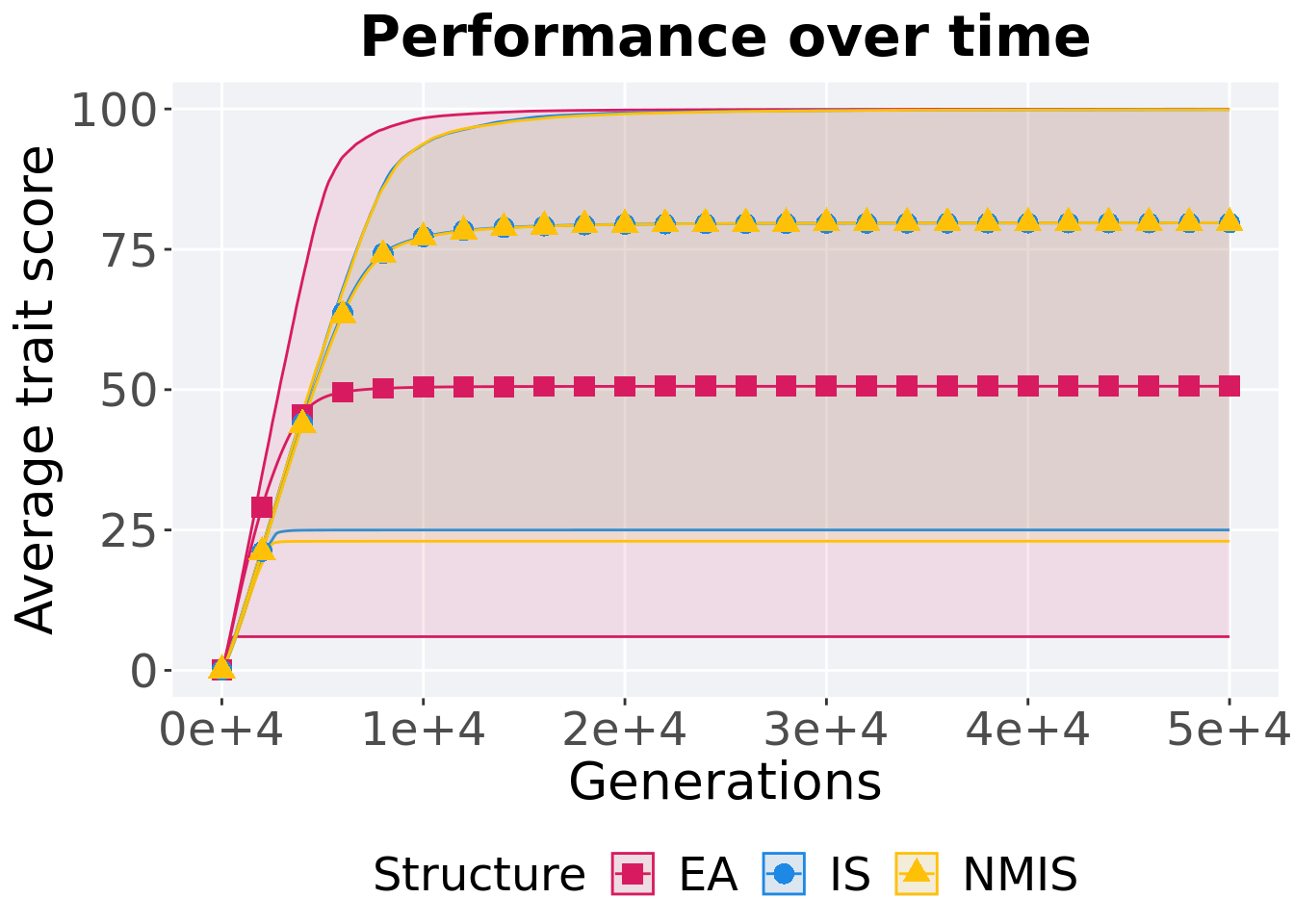
17.2.1.2 Best performance
First generation a satisfactory solution is found throughout the 50,000 generations.
filter(mi5000_best, Diagnostic == 'MULTIPATH_EXPLORATION' & `Selection\nScheme` == 'TRUNCATION' & VAR == 'pop_fit_max') %>%
  ggplot(., aes(x = Structure, y = VAL / DIMENSIONALITY, color = Structure, fill = Structure, shape = Structure)) +
  geom_flat_violin(position = position_nudge(x = .2, y = 0), scale = 'width', alpha = 0.2) +
  geom_point(position = position_jitter(width = .1), size = 1.5, alpha = 1.0) +
  geom_boxplot(color = 'black', width = .2, outlier.shape = NA, alpha = 0.0) +
  scale_y_continuous(
    name="Average trait score"
  ) +
  scale_x_discrete(
    name="Structure"
  )+
  scale_shape_manual(values=SHAPE)+
  scale_colour_manual(values = cb_palette, ) +
  scale_fill_manual(values = cb_palette) +
  ggtitle('Best performance')+
  p_theme + coord_flip()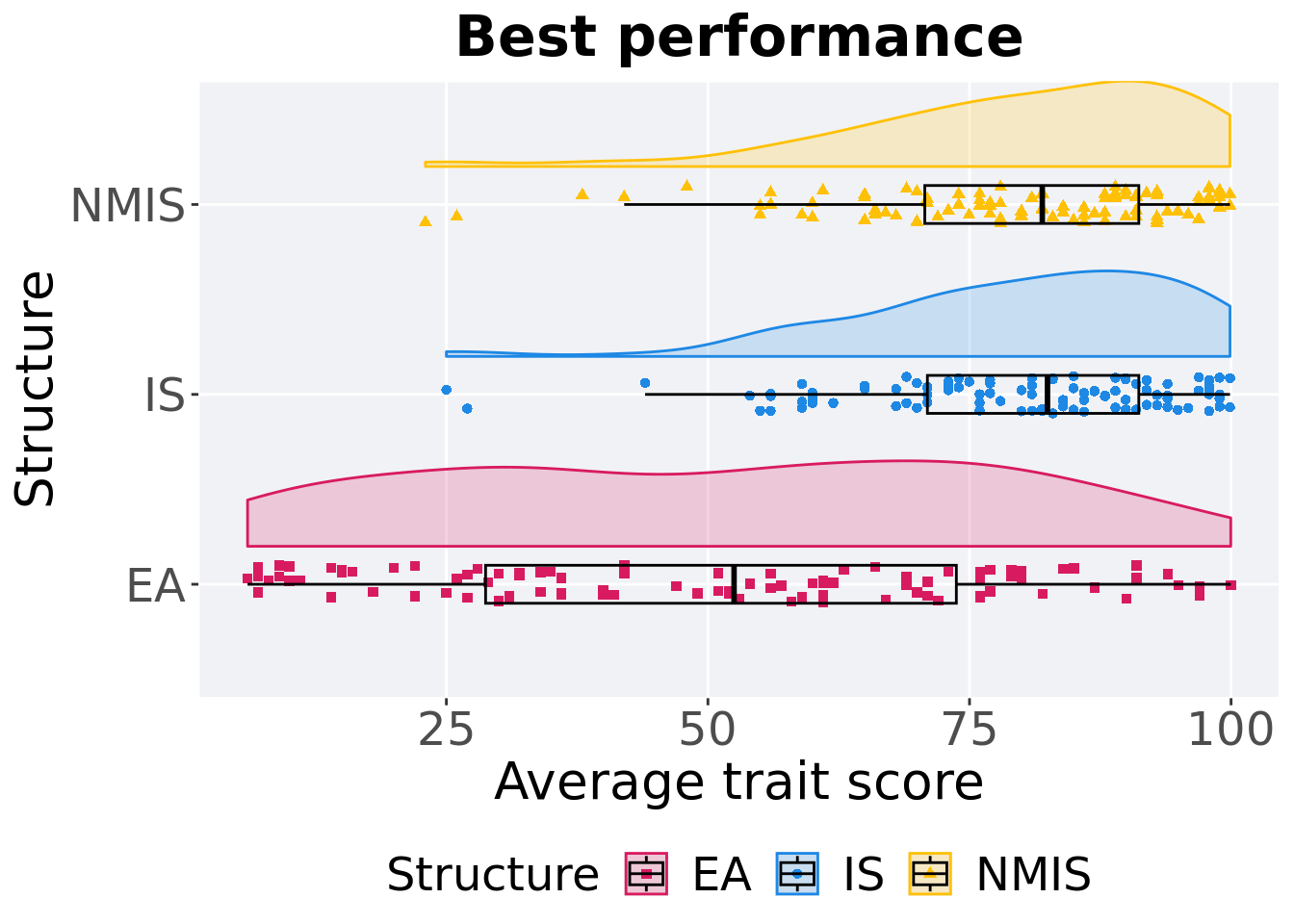
17.2.1.2.1 Stats
Summary statistics for the first generation a satisfactory solution is found.
performance = filter(mi5000_best, Diagnostic == 'MULTIPATH_EXPLORATION' & `Selection\nScheme` == 'TRUNCATION' & VAR == 'pop_fit_max')
performance %>%
  group_by(Structure) %>%
  dplyr::summarise(
    count = n(),
    na_cnt = sum(is.na(VAL)),
    min = min(VAL, na.rm = TRUE) / DIMENSIONALITY,
    median = median(VAL, na.rm = TRUE) / DIMENSIONALITY,
    mean = mean(VAL, na.rm = TRUE) / DIMENSIONALITY,
    max = max(VAL, na.rm = TRUE) / DIMENSIONALITY,
    IQR = IQR(VAL, na.rm = TRUE) / DIMENSIONALITY
  )
## # A tibble: 3 x 8
## Structure count na_cnt min median mean max IQR
## <fct> <int> <int> <dbl> <dbl> <dbl> <dbl> <dbl>
## 1 EA 100 0 6 52.5 50.6 100. 45.0
## 2 IS 100 0 25.0 82.5 79.7 99.9 20.2
## 3 NMIS 100 0 23.0 82.0 79.7 99.9 20.5Kruskal–Wallis test provides evidence of difference among selection schemes.
##
##  Kruskal-Wallis rank sum test
##
## data:  VAL by Structure
## Kruskal-Wallis chi-squared = 75.468, df = 2, p-value < 2.2e-16
Results for post-hoc Wilcoxon rank-sum test with a Bonferroni correction.
pairwise.wilcox.test(x = performance$VAL, g = performance$Structure, p.adjust.method = "bonferroni",
                     paired = FALSE, conf.int = FALSE, alternative = 'g')
##
## Pairwise comparisons using Wilcoxon rank sum test with continuity correction
##
## data: performance$VAL and performance$Structure
##
## EA IS
## IS 8.2e-14 -
## NMIS 8.7e-14 1
##
## P value adjustment method: bonferroni17.2.1.3 Final performance
First generation a satisfactory solution is found throughout the 50,000 generations.
filter(mi5000_over_time, Diagnostic == 'MULTIPATH_EXPLORATION' & `Selection\nScheme` == 'TRUNCATION' & Generations == 50000) %>%
  ggplot(., aes(x = Structure, y = pop_fit_max / DIMENSIONALITY, color = Structure, fill = Structure, shape = Structure)) +
  geom_flat_violin(position = position_nudge(x = .2, y = 0), scale = 'width', alpha = 0.2) +
  geom_point(position = position_jitter(width = .1), size = 1.5, alpha = 1.0) +
  geom_boxplot(color = 'black', width = .2, outlier.shape = NA, alpha = 0.0) +
  scale_y_continuous(
    name="Average trait score"
  ) +
  scale_x_discrete(
    name="Structure"
  )+
  scale_shape_manual(values=SHAPE)+
  scale_colour_manual(values = cb_palette, ) +
  scale_fill_manual(values = cb_palette) +
  ggtitle('Final performance')+
  p_theme + coord_flip()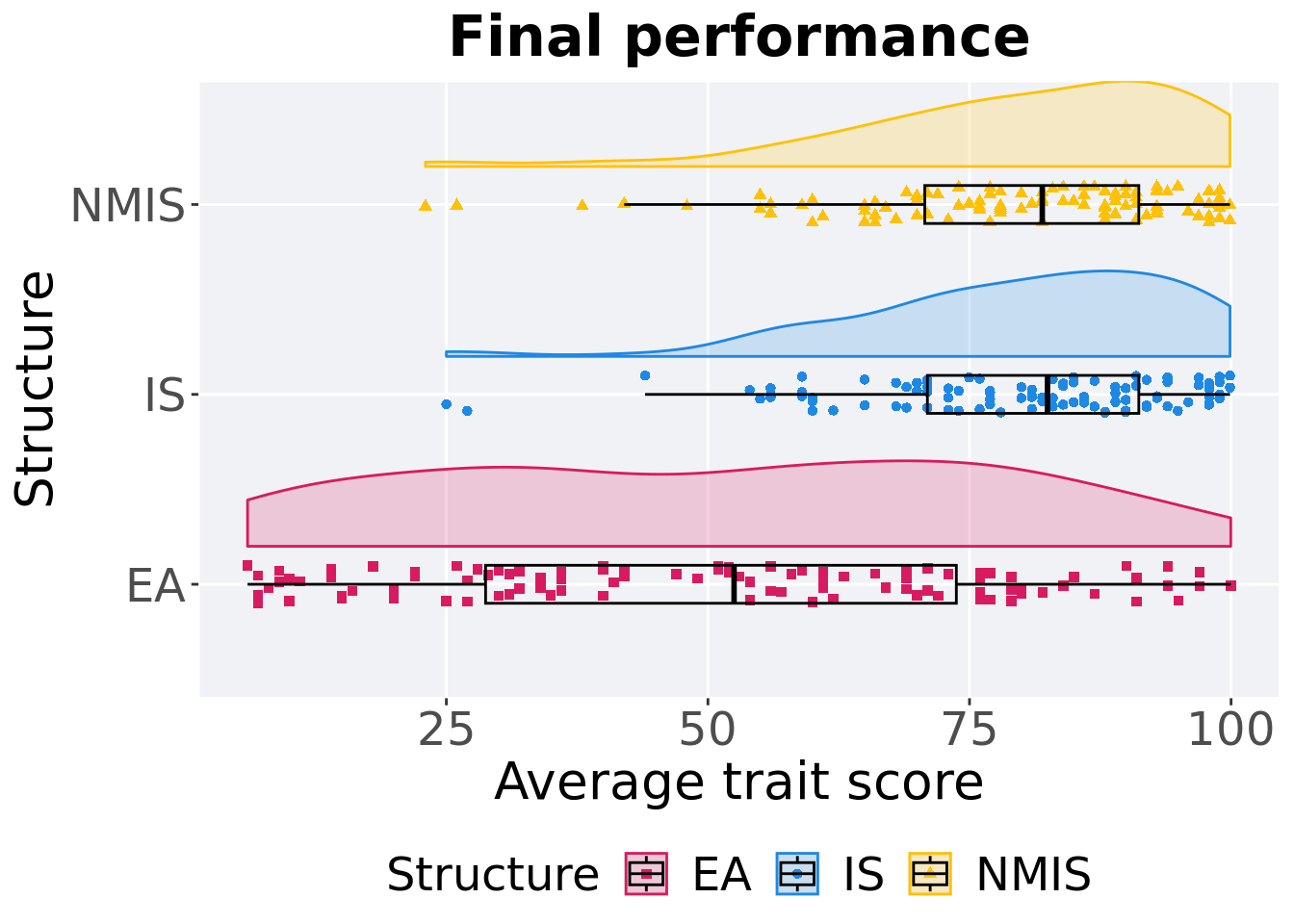
17.2.1.3.1 Stats
Summary statistics for the first generation a satisfactory solution is found.
performance = filter(mi5000_over_time, Diagnostic == 'MULTIPATH_EXPLORATION' & `Selection\nScheme` == 'TRUNCATION' & Generations == 50000)
performance %>%
  group_by(Structure) %>%
  dplyr::summarise(
    count = n(),
    na_cnt = sum(is.na(pop_fit_max)),
    min = min(pop_fit_max / DIMENSIONALITY, na.rm = TRUE),
    median = median(pop_fit_max / DIMENSIONALITY, na.rm = TRUE),
    mean = mean(pop_fit_max / DIMENSIONALITY, na.rm = TRUE),
    max = max(pop_fit_max / DIMENSIONALITY, na.rm = TRUE),
    IQR = IQR(pop_fit_max / DIMENSIONALITY, na.rm = TRUE)
  )
## # A tibble: 3 x 8
## Structure count na_cnt min median mean max IQR
## <fct> <int> <int> <dbl> <dbl> <dbl> <dbl> <dbl>
## 1 EA 100 0 6 52.5 50.6 100. 45.0
## 2 IS 100 0 25.0 82.5 79.7 99.9 20.2
## 3 NMIS 100 0 23.0 82.0 79.7 99.9 20.5Kruskal–Wallis test provides evidence of difference among selection schemes.
##
##  Kruskal-Wallis rank sum test
##
## data:  pop_fit_max by Structure
## Kruskal-Wallis chi-squared = 75.468, df = 2, p-value < 2.2e-16
Results for post-hoc Wilcoxon rank-sum test with a Bonferroni correction.
pairwise.wilcox.test(x = performance$pop_fit_max, g = performance$Structure, p.adjust.method = "bonferroni",
                     paired = FALSE, conf.int = FALSE, alternative = 'g')
##
## Pairwise comparisons using Wilcoxon rank sum test with continuity correction
##
## data: performance$pop_fit_max and performance$Structure
##
## EA IS
## IS 8.2e-14 -
## NMIS 8.7e-14 1
##
## P value adjustment method: bonferroni17.2.2 Generation satisfactory solution found
First generation a satisfactory solution is found throughout the 50,000 generations.
filter(mi5000_ssf, Diagnostic == 'MULTIPATH_EXPLORATION' & `Selection\nScheme` == 'TRUNCATION'& Generations <= GENERATIONS) %>%
  ggplot(., aes(x = Structure, y = Generations, color = Structure, fill = Structure, shape = Structure)) +
    geom_flat_violin(position = position_nudge(x = .2, y = 0), scale = 'width', alpha = 0.2) +
  geom_point(position = position_jitter(width = .1), size = 1.5, alpha = 1.0) +
  geom_boxplot(color = 'black', width = .2, outlier.shape = NA, alpha = 0.0) +
  scale_shape_manual(values=SHAPE)+
  scale_y_continuous(
    name="Generations"
  ) +
  scale_x_discrete(
    name="Structure"
  ) +
  scale_colour_manual(values = cb_palette) +
  scale_fill_manual(values = cb_palette) +
  p_theme + coord_flip()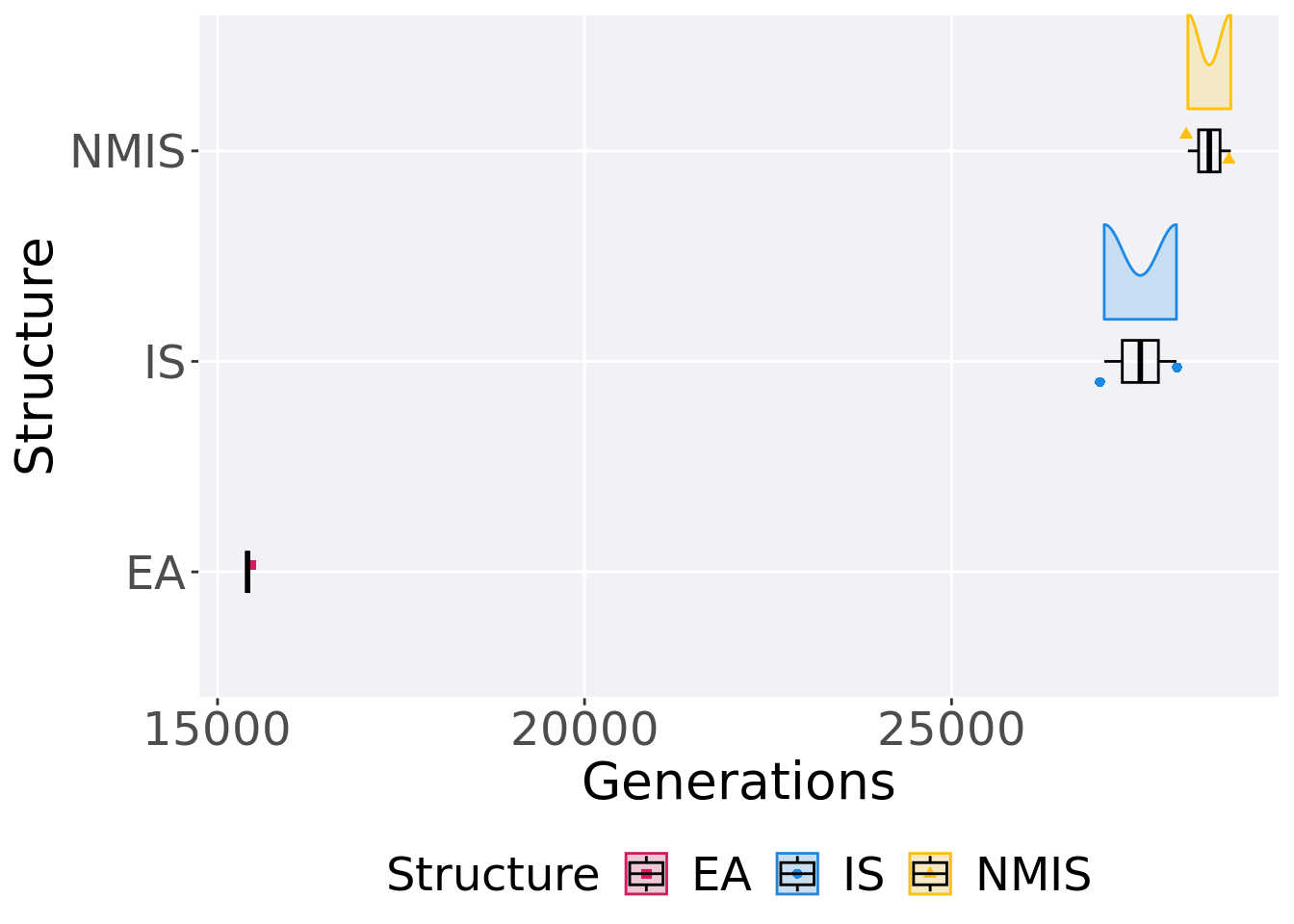
17.2.2.1 Stats
Summary statistics for the first generation a satisfactory solution is found.
ssf = filter(mi5000_ssf, Diagnostic == 'MULTIPATH_EXPLORATION' & `Selection\nScheme` == 'TRUNCATION' & Generations < 60000)
ssf %>%
  group_by(Structure) %>%
  dplyr::summarise(
    count = n(),
    na_cnt = sum(is.na(Generations)),
    min = min(Generations, na.rm = TRUE),
    median = median(Generations, na.rm = TRUE),
    mean = mean(Generations, na.rm = TRUE),
    max = max(Generations, na.rm = TRUE),
    IQR = IQR(Generations, na.rm = TRUE)
  )
## # A tibble: 3 x 8
## Structure count na_cnt min median mean max IQR
## <fct> <int> <int> <int> <dbl> <dbl> <int> <dbl>
## 1 EA 1 0 15409 15409 15409 15409 0
## 2 IS 2 0 27080 27572 27572 28064 492
## 3 NMIS 2 0 28220 28512 28512 28804 292Kruskal–Wallis test provides evidence of no difference among selection schemes.
##
##  Kruskal-Wallis rank sum test
##
## data:  Generations by Structure
## Kruskal-Wallis chi-squared = 3.6, df = 2, p-value = 0.1653
17.2.3 Activation gene coverage
Activation gene coverage analysis.
17.2.3.1 Coverage over time
Activation gene coverage over time.
# data for lines and shading on plots
lines = filter(mi5000_over_time, Diagnostic == 'MULTIPATH_EXPLORATION' & `Selection\nScheme` == 'TRUNCATION') %>%
  group_by(Structure, Generations) %>%
  dplyr::summarise(
    min = min(pop_act_cov),
    mean = mean(pop_act_cov),
    max = max(pop_act_cov)
  )
## `summarise()` has grouped output by 'Structure'. You can override using the
## `.groups` argument.ggplot(lines, aes(x=Generations, y=mean, group = Structure, fill = Structure, color = Structure, shape = Structure)) +
geom_ribbon(aes(ymin = min, ymax = max), alpha = 0.1) +
geom_line(size = 0.5) +
geom_point(data = filter(lines, Generations %% 2000 == 0), size = 1.5, stroke = 2.0, alpha = 1.0) +
scale_y_continuous(
name="Coverage"
) +
scale_x_continuous(
name="Generations",
limits=c(0, 50000),
breaks=c(0, 10000, 20000, 30000, 40000, 50000),
labels=c("0e+4", "1e+4", "2e+4", "3e+4", "4e+4", "5e+4")
) +
scale_shape_manual(values=SHAPE)+
scale_colour_manual(values = cb_palette) +
scale_fill_manual(values = cb_palette) +
ggtitle('Activation gene coverage over time')+
p_theme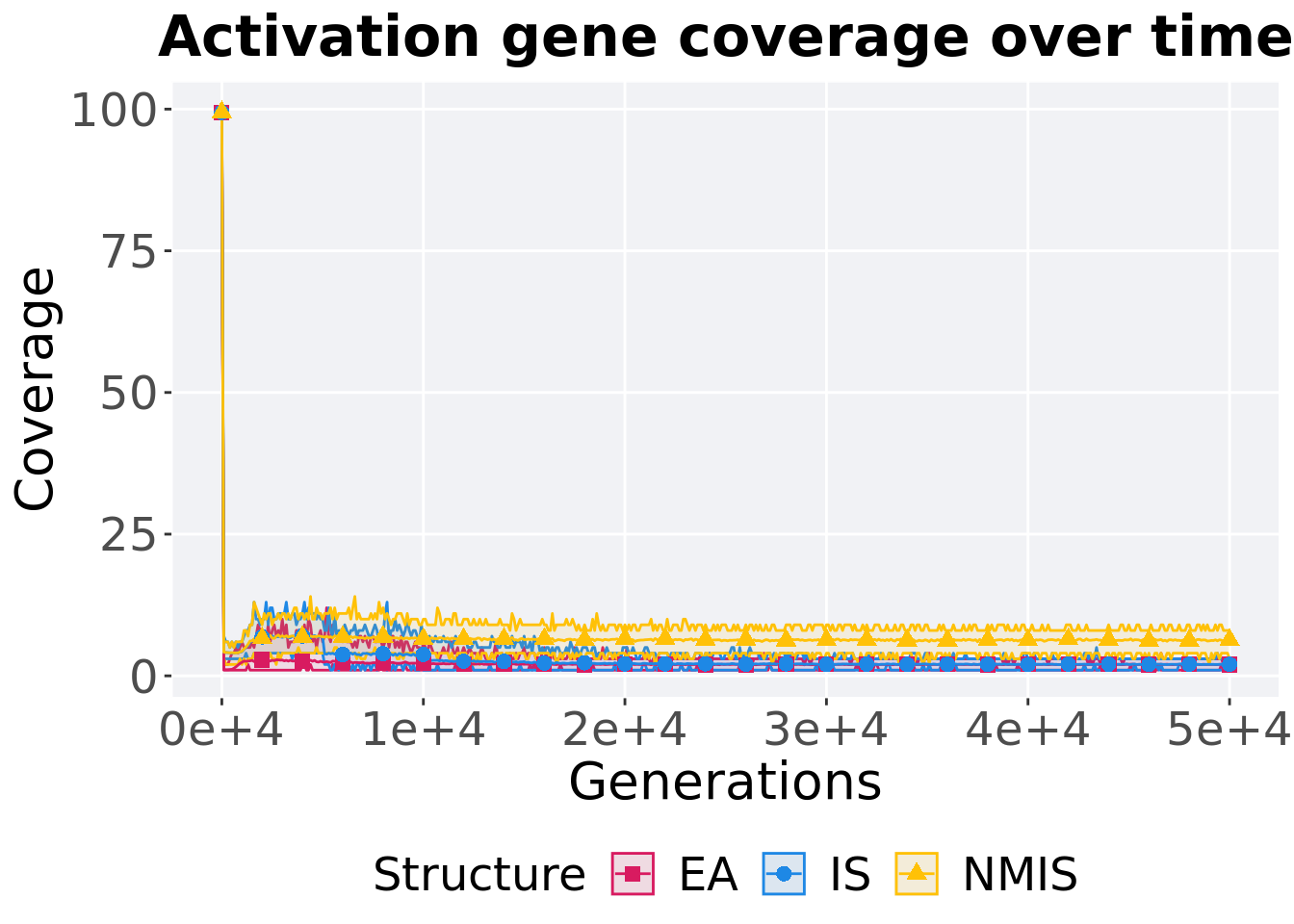
17.2.3.2 End of 50,000 generations
Activation gene coverage in the population at the end of 50,000 generations.
### end of run
filter(mi5000_over_time, Diagnostic == 'MULTIPATH_EXPLORATION' & `Selection\nScheme` == 'TRUNCATION' & Generations == 50000) %>%
  ggplot(., aes(x = Structure, y = pop_act_cov, color = Structure, fill = Structure, shape = Structure)) +
  geom_flat_violin(position = position_nudge(x = .2, y = 0), scale = 'width', alpha = 0.3) +
  geom_point(position = position_jitter(height = .05, width = .05), size = 1.5, alpha = 0.5) +
  geom_boxplot(color = 'black', width = .2, outlier.shape = NA, alpha = 0.0) +
  scale_shape_manual(values=SHAPE)+
  scale_y_continuous(
    name="Coverage"
  ) +
  scale_x_discrete(
    name="Structure"
  ) +
  scale_colour_manual(values = cb_palette) +
  scale_fill_manual(values = cb_palette) +
  ggtitle('Final activation gene coverage')+
  p_theme + coord_flip()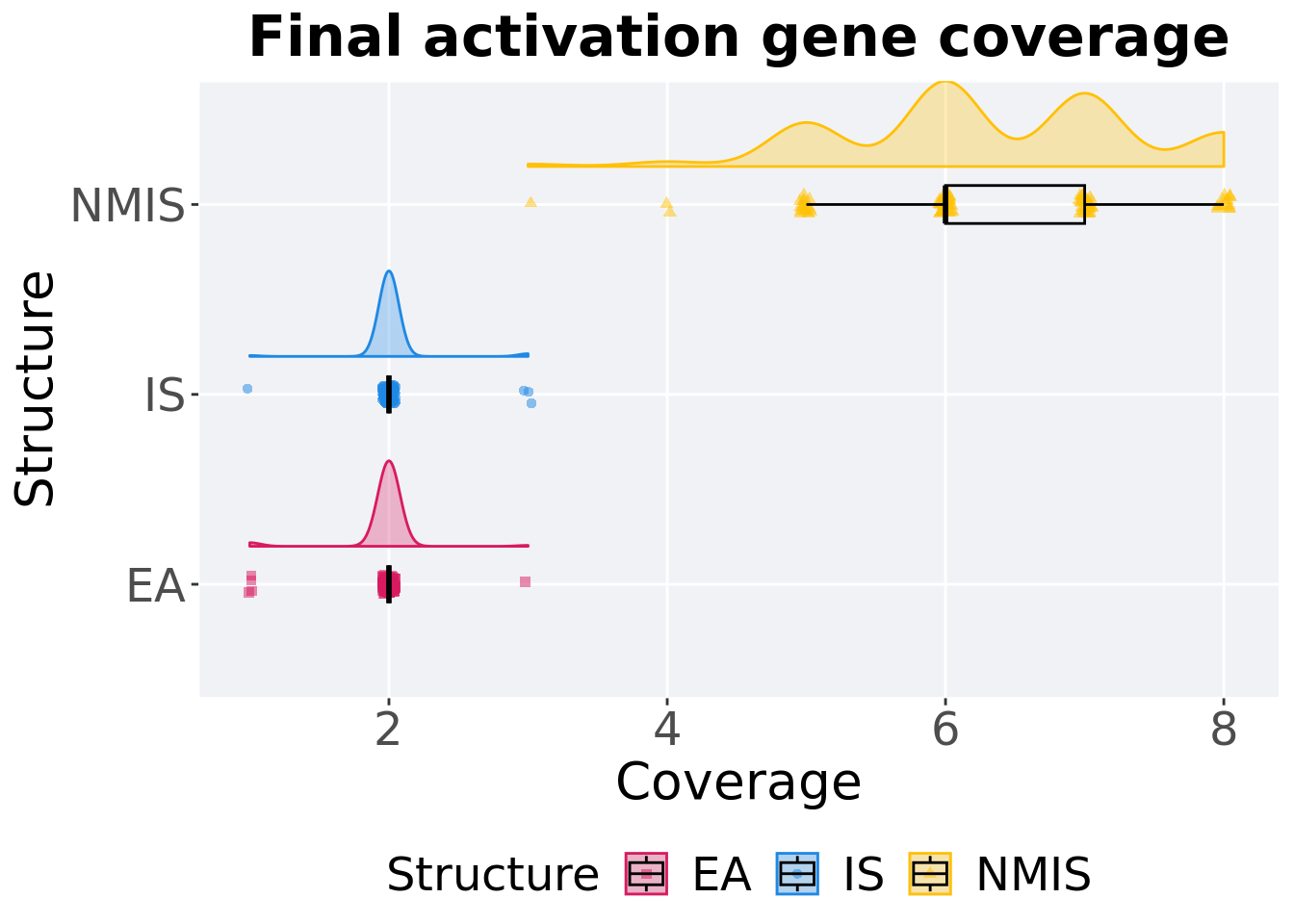
17.2.3.2.1 Stats
Summary statistics for activation gene coverage.
coverage = filter(mi5000_over_time, Diagnostic == 'MULTIPATH_EXPLORATION' & `Selection\nScheme` == 'TRUNCATION' & Generations == 50000)
coverage %>%
  group_by(Structure) %>%
  dplyr::summarise(
    count = n(),
    na_cnt = sum(is.na(pop_act_cov)),
    min = min(pop_act_cov, na.rm = TRUE),
    median = median(pop_act_cov, na.rm = TRUE),
    mean = mean(pop_act_cov, na.rm = TRUE),
    max = max(pop_act_cov, na.rm = TRUE),
    IQR = IQR(pop_act_cov, na.rm = TRUE)
  )
## # A tibble: 3 x 8
## Structure count na_cnt min median mean max IQR
## <fct> <int> <int> <int> <dbl> <dbl> <int> <dbl>
## 1 EA 100 0 1 2 1.97 3 0
## 2 IS 100 0 1 2 2.02 3 0
## 3 NMIS 100 0 3 6 6.33 8 1Kruskal–Wallis test provides evidence of difference among activation gene coverage.
##
##  Kruskal-Wallis rank sum test
##
## data:  pop_act_cov by Structure
## Kruskal-Wallis chi-squared = 269.84, df = 2, p-value < 2.2e-16
Results for post-hoc Wilcoxon rank-sum test with a Bonferroni correction on activation gene coverage.
pairwise.wilcox.test(x = coverage$pop_act_cov, g = coverage$Structure, p.adjust.method = "bonferroni",
                     paired = FALSE, conf.int = FALSE, alternative = 'g')
##
## Pairwise comparisons using Wilcoxon rank sum test with continuity correction
##
## data: coverage$pop_act_cov and coverage$Structure
##
## EA IS
## IS 0.15 -
## NMIS <2e-16 <2e-16
##
## P value adjustment method: bonferroni17.3 Tournament selection
Here we analyze how the different population structures affect tournament selection (size 8) on the contradictory objectives diagnostic.
17.3.1 Performance
17.3.1.1 Performance over time
lines = filter(mi5000_over_time, Diagnostic == 'MULTIPATH_EXPLORATION' & `Selection\nScheme` == 'TOURNAMENT') %>%
  group_by(Structure, Generations) %>%
  dplyr::summarise(
    min = min(pop_fit_max) / DIMENSIONALITY,
    mean = mean(pop_fit_max) / DIMENSIONALITY,
    max = max(pop_fit_max) / DIMENSIONALITY
  )
ggplot(lines, aes(x=Generations, y=mean, group = Structure, fill = Structure, color = Structure, shape = Structure)) +
  geom_ribbon(aes(ymin = min, ymax = max), alpha = 0.1) +
  geom_line(size = 0.5) +
  geom_point(data = filter(lines, Generations %% 2000 == 0), size = 2.5, stroke = 2.0, alpha = 1.0) +
  scale_y_continuous(
    name="Average trait score"
  ) +
  scale_x_continuous(
    name="Generations",
    limits=c(0, 50000),
    breaks=c(0, 10000, 20000, 30000, 40000, 50000),
    labels=c("0e+4", "1e+4", "2e+4", "3e+4", "4e+4", "5e+4")

  ) +
  scale_shape_manual(values=SHAPE)+
  scale_colour_manual(values = cb_palette) +
  scale_fill_manual(values = cb_palette) +
  ggtitle("Performance over time") +
  p_theme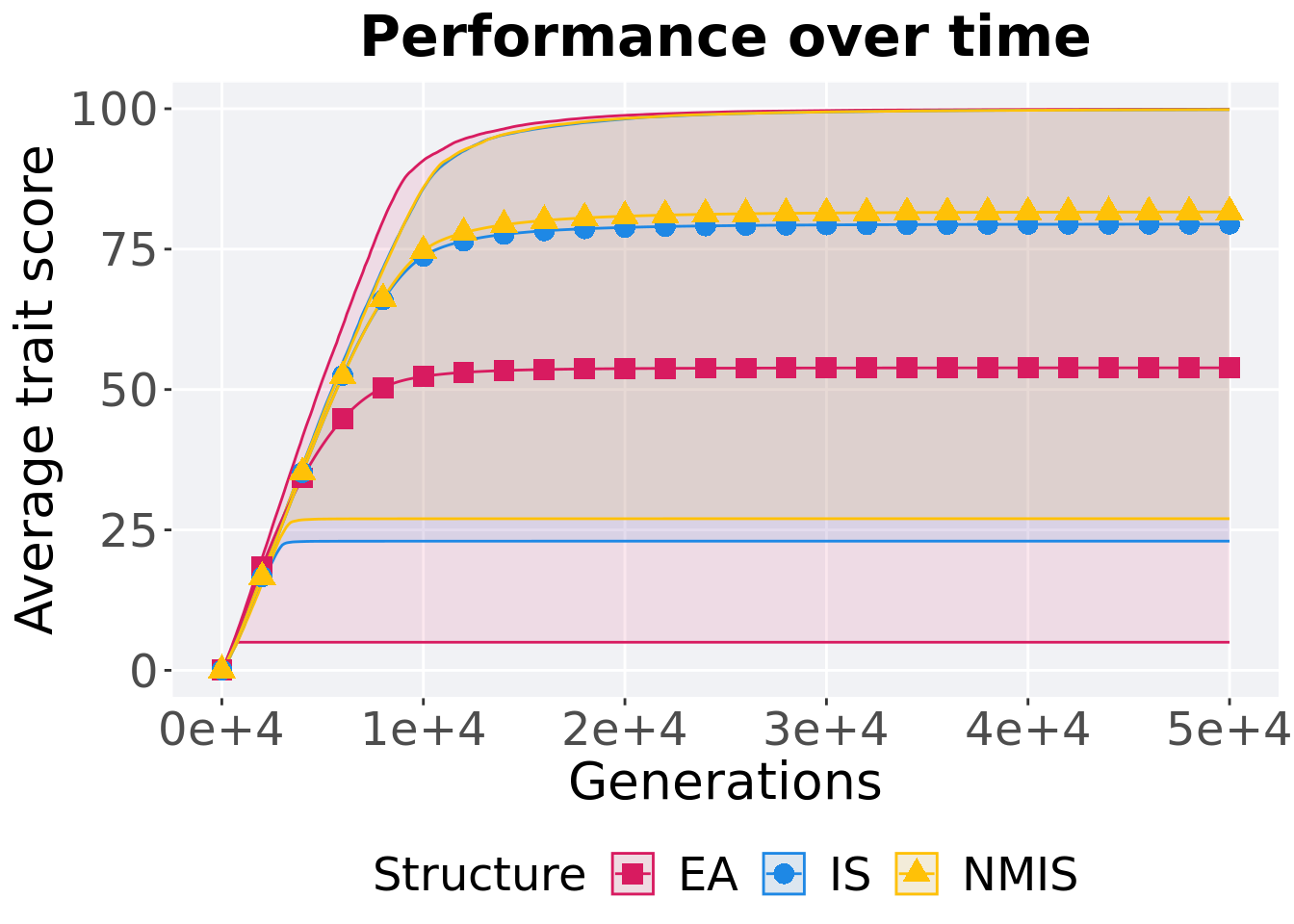
17.3.1.2 Best performance
First generation a satisfactory solution is found throughout the 50,000 generations.
filter(mi5000_best, Diagnostic == 'MULTIPATH_EXPLORATION' & `Selection\nScheme` == 'TOURNAMENT' & VAR == 'pop_fit_max') %>%
  ggplot(., aes(x = Structure, y = VAL / DIMENSIONALITY, color = Structure, fill = Structure, shape = Structure)) +
  geom_flat_violin(position = position_nudge(x = .2, y = 0), scale = 'width', alpha = 0.2) +
  geom_point(position = position_jitter(width = .1), size = 1.5, alpha = 1.0) +
  geom_boxplot(color = 'black', width = .2, outlier.shape = NA, alpha = 0.0) +
  scale_y_continuous(
    name="Average trait score"
  ) +
  scale_x_discrete(
    name="Structure"
  )+
  scale_shape_manual(values=SHAPE)+
  scale_colour_manual(values = cb_palette, ) +
  scale_fill_manual(values = cb_palette) +
  ggtitle('Best performance')+
  p_theme + coord_flip()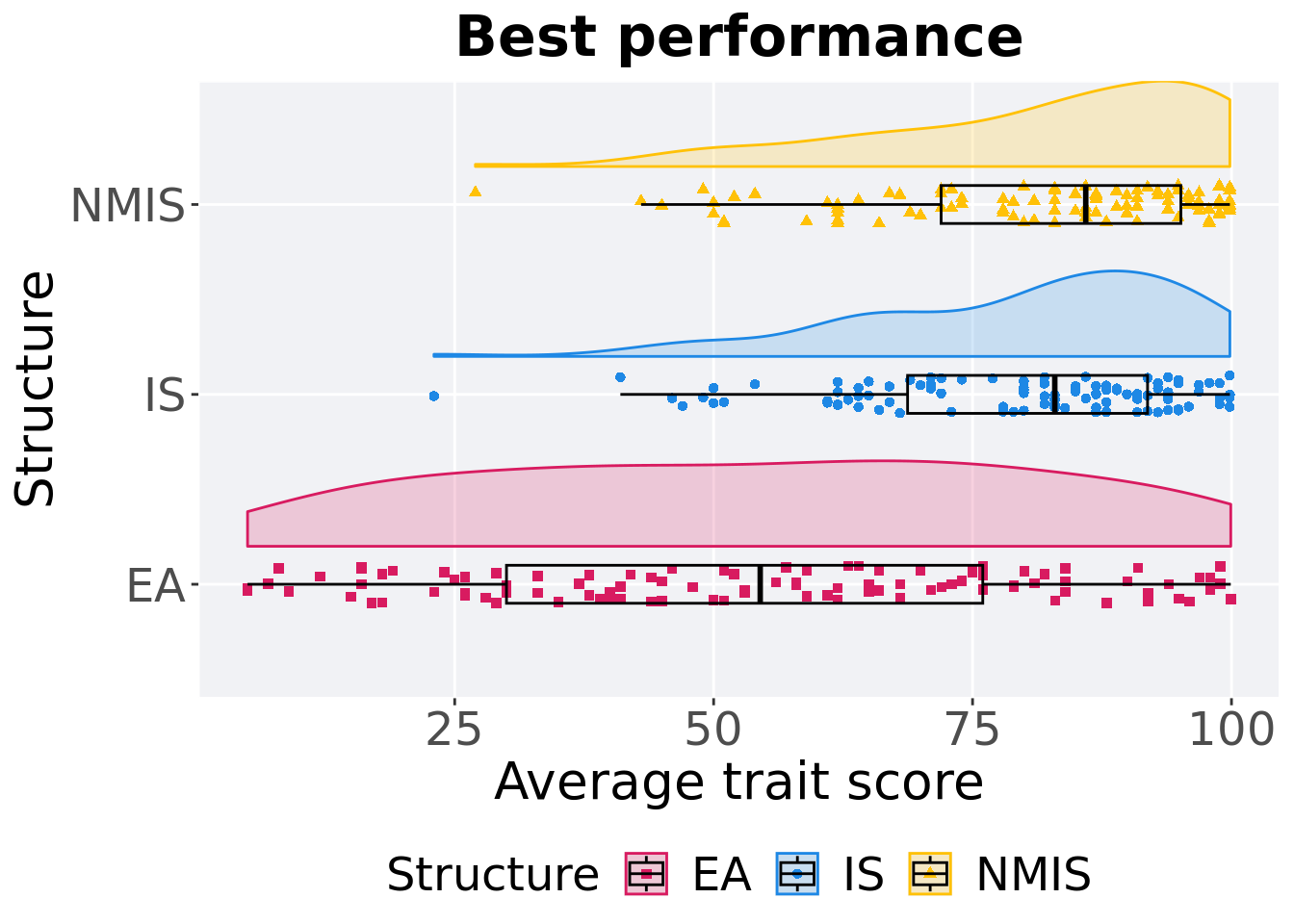
17.3.1.2.1 Stats
Summary statistics for the first generation a satisfactory solution is found.
performance = filter(mi5000_best, Diagnostic == 'MULTIPATH_EXPLORATION' & `Selection\nScheme` == 'TOURNAMENT' & VAR == 'pop_fit_max')
performance %>%
  group_by(Structure) %>%
  dplyr::summarise(
    count = n(),
    na_cnt = sum(is.na(VAL)),
    min = min(VAL, na.rm = TRUE) / DIMENSIONALITY,
    median = median(VAL, na.rm = TRUE) / DIMENSIONALITY,
    mean = mean(VAL, na.rm = TRUE) / DIMENSIONALITY,
    max = max(VAL, na.rm = TRUE) / DIMENSIONALITY,
    IQR = IQR(VAL, na.rm = TRUE) / DIMENSIONALITY
  )
## # A tibble: 3 x 8
## Structure count na_cnt min median mean max IQR
## <fct> <int> <int> <dbl> <dbl> <dbl> <dbl> <dbl>
## 1 EA 100 0 5 54.5 53.9 99.9 46.0
## 2 IS 100 0 23.0 82.9 79.5 99.8 23.2
## 3 NMIS 100 0 27.0 85.9 81.6 99.8 23.1Kruskal–Wallis test provides evidence of difference among selection schemes.
##
##  Kruskal-Wallis rank sum test
##
## data:  VAL by Structure
## Kruskal-Wallis chi-squared = 63.856, df = 2, p-value = 1.361e-14
Results for post-hoc Wilcoxon rank-sum test with a Bonferroni correction.
pairwise.wilcox.test(x = performance$VAL, g = performance$Structure, p.adjust.method = "bonferroni",
                     paired = FALSE, conf.int = FALSE, alternative = 'g')
##
## Pairwise comparisons using Wilcoxon rank sum test with continuity correction
##
## data: performance$VAL and performance$Structure
##
## EA IS
## IS 6.2e-11 -
## NMIS 1.5e-12 0.37
##
## P value adjustment method: bonferroni17.3.1.3 Final performance
First generation a satisfactory solution is found throughout the 50,000 generations.
filter(mi5000_over_time, Diagnostic == 'MULTIPATH_EXPLORATION' & `Selection\nScheme` == 'TOURNAMENT' & Generations == 50000) %>%
  ggplot(., aes(x = Structure, y = pop_fit_max / DIMENSIONALITY, color = Structure, fill = Structure, shape = Structure)) +
  geom_flat_violin(position = position_nudge(x = .2, y = 0), scale = 'width', alpha = 0.2) +
  geom_point(position = position_jitter(width = .1), size = 1.5, alpha = 1.0) +
  geom_boxplot(color = 'black', width = .2, outlier.shape = NA, alpha = 0.0) +
  scale_y_continuous(
    name="Average trait score"
  ) +
  scale_x_discrete(
    name="Structure"
  )+
  scale_shape_manual(values=SHAPE)+
  scale_colour_manual(values = cb_palette, ) +
  scale_fill_manual(values = cb_palette) +
  ggtitle('Final performance')+
  p_theme + coord_flip()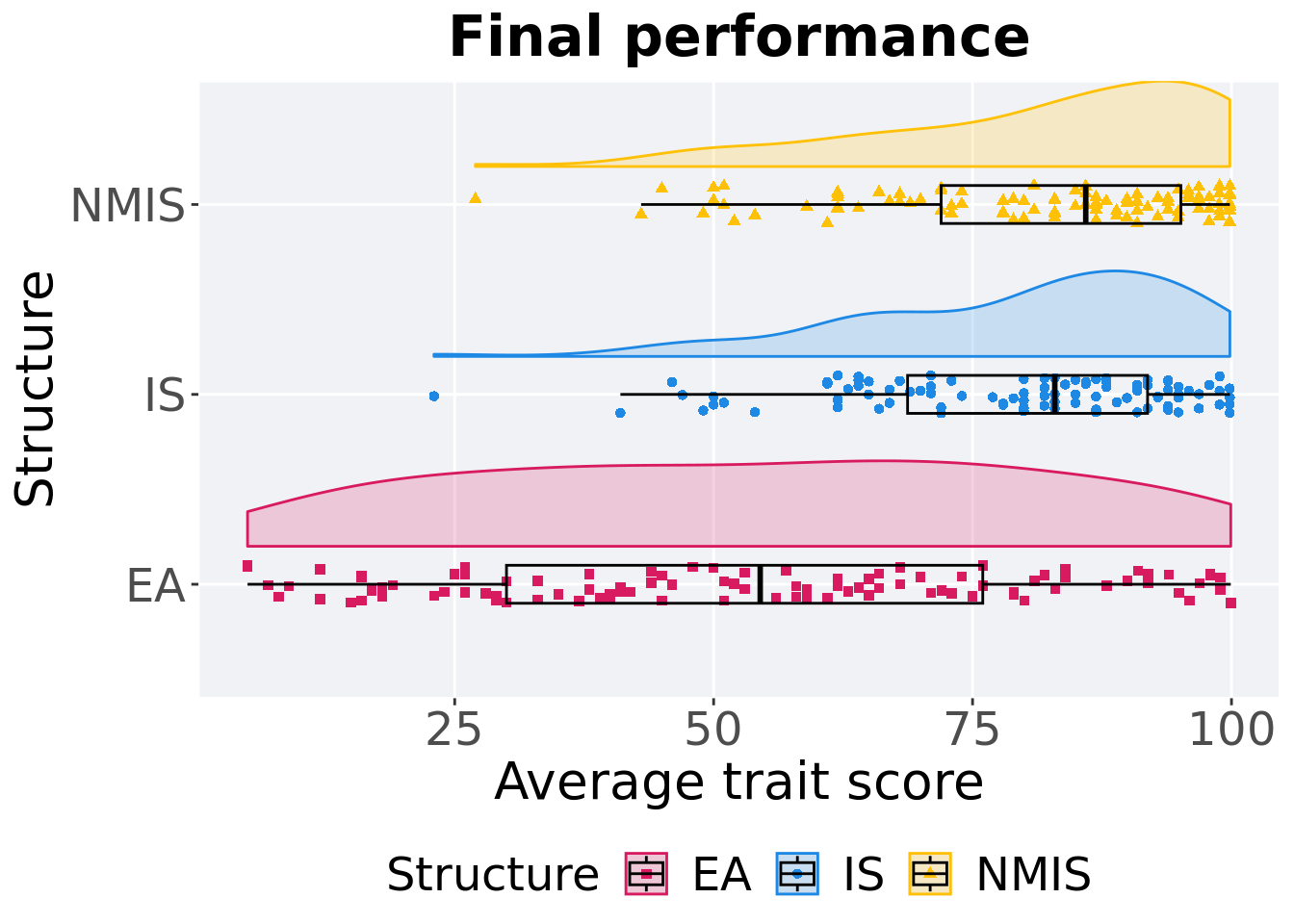
17.3.1.3.1 Stats
Summary statistics for the first generation a satisfactory solution is found.
performance = filter(mi5000_over_time, Diagnostic == 'MULTIPATH_EXPLORATION' & `Selection\nScheme` == 'TOURNAMENT' & Generations == 50000)
performance %>%
  group_by(Structure) %>%
  dplyr::summarise(
    count = n(),
    na_cnt = sum(is.na(pop_fit_max)),
    min = min(pop_fit_max / DIMENSIONALITY, na.rm = TRUE),
    median = median(pop_fit_max / DIMENSIONALITY, na.rm = TRUE),
    mean = mean(pop_fit_max / DIMENSIONALITY, na.rm = TRUE),
    max = max(pop_fit_max / DIMENSIONALITY, na.rm = TRUE),
    IQR = IQR(pop_fit_max / DIMENSIONALITY, na.rm = TRUE)
  )
## # A tibble: 3 x 8
## Structure count na_cnt min median mean max IQR
## <fct> <int> <int> <dbl> <dbl> <dbl> <dbl> <dbl>
## 1 EA 100 0 5 54.5 53.9 99.9 46.0
## 2 IS 100 0 23.0 82.9 79.5 99.8 23.2
## 3 NMIS 100 0 27.0 85.9 81.6 99.8 23.1Kruskal–Wallis test provides evidence of difference among selection schemes.
##
##  Kruskal-Wallis rank sum test
##
## data:  pop_fit_max by Structure
## Kruskal-Wallis chi-squared = 63.856, df = 2, p-value = 1.361e-14
Results for post-hoc Wilcoxon rank-sum test with a Bonferroni correction.
pairwise.wilcox.test(x = performance$pop_fit_max, g = performance$Structure, p.adjust.method = "bonferroni",
                     paired = FALSE, conf.int = FALSE, alternative = 'g')
##
## Pairwise comparisons using Wilcoxon rank sum test with continuity correction
##
## data: performance$pop_fit_max and performance$Structure
##
## EA IS
## IS 6.2e-11 -
## NMIS 1.5e-12 0.37
##
## P value adjustment method: bonferroni17.3.2 Generation satisfactory solution found
First generation a satisfactory solution is found throughout the 50,000 generations.
filter(mi5000_ssf, Diagnostic == 'MULTIPATH_EXPLORATION' & `Selection\nScheme` == 'TOURNAMENT'& Generations <= GENERATIONS) %>%
  ggplot(., aes(x = Structure, y = Generations, color = Structure, fill = Structure, shape = Structure)) +
    geom_flat_violin(position = position_nudge(x = .2, y = 0), scale = 'width', alpha = 0.2) +
  geom_point(position = position_jitter(width = .1), size = 1.5, alpha = 1.0) +
  geom_boxplot(color = 'black', width = .2, outlier.shape = NA, alpha = 0.0) +
  scale_shape_manual(values=SHAPE)+
  scale_y_continuous(
    name="Generations"
  ) +
  scale_x_discrete(
    name="Structure"
  ) +
  scale_colour_manual(values = cb_palette) +
  scale_fill_manual(values = cb_palette) +
  p_theme + coord_flip()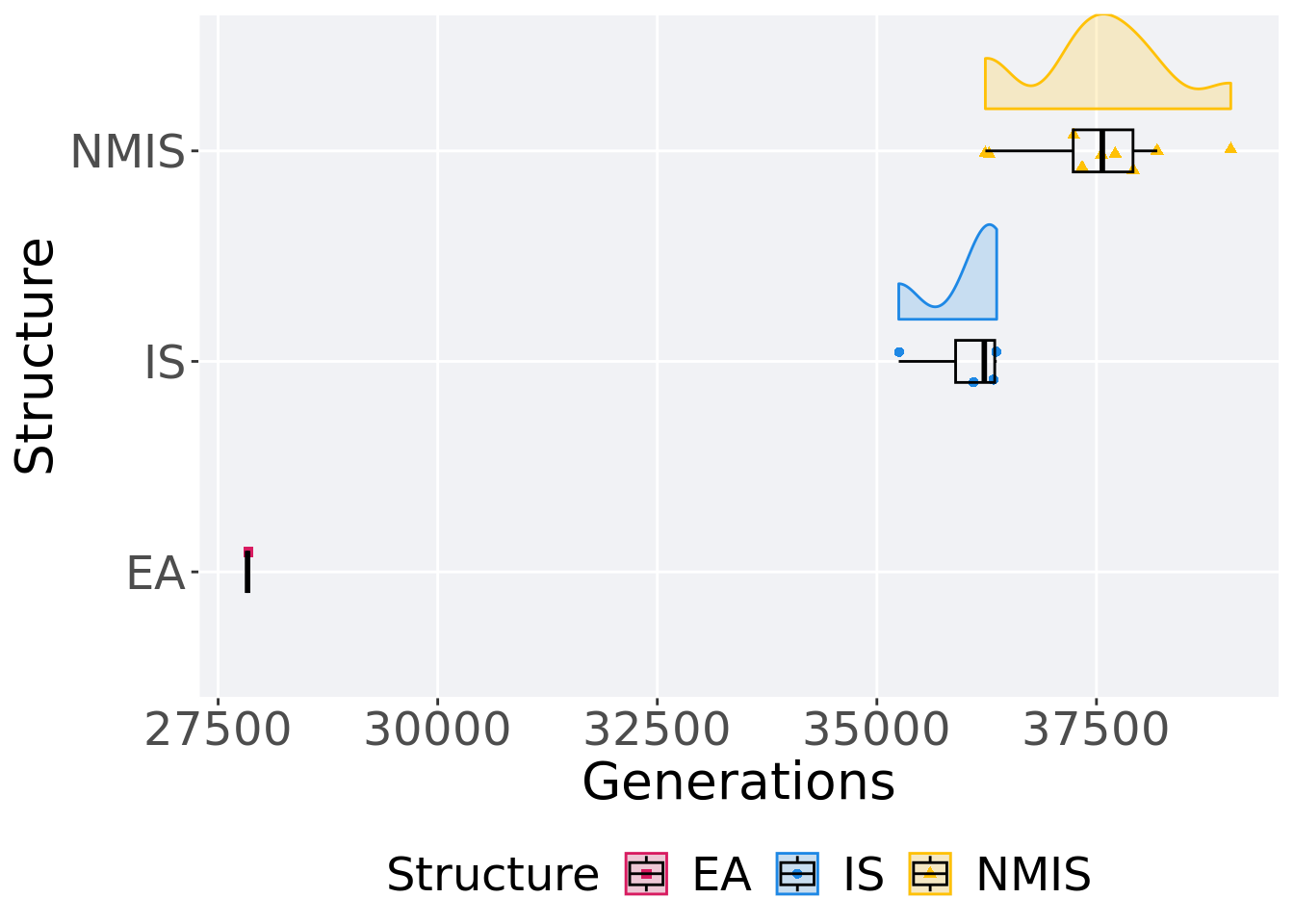
17.3.2.1 Stats
Summary statistics for the first generation a satisfactory solution is found.
ssf = filter(mi5000_ssf, Diagnostic == 'MULTIPATH_EXPLORATION' & `Selection\nScheme` == 'TOURNAMENT' & Generations < 60000)
ssf %>%
  group_by(Structure) %>%
  dplyr::summarise(
    count = n(),
    na_cnt = sum(is.na(Generations)),
    min = min(Generations, na.rm = TRUE),
    median = median(Generations, na.rm = TRUE),
    mean = mean(Generations, na.rm = TRUE),
    max = max(Generations, na.rm = TRUE),
    IQR = IQR(Generations, na.rm = TRUE)
  )
## # A tibble: 3 x 8
## Structure count na_cnt min median mean max IQR
## <fct> <int> <int> <int> <dbl> <dbl> <int> <dbl>
## 1 EA 1 0 27835 27835 27835 27835 0
## 2 IS 4 0 35249 36223 36015. 36364 445.
## 3 NMIS 9 0 36235 37567 37498. 39029 681Kruskal–Wallis test provides evidence of no difference among selection schemes.
##
##  Kruskal-Wallis rank sum test
##
## data:  Generations by Structure
## Kruskal-Wallis chi-squared = 6.6444, df = 2, p-value = 0.03607pairwise.wilcox.test(x = ssf$Generations, g = ssf$Structure, p.adjust.method = "bonferroni",
paired = FALSE, conf.int = FALSE, alternative = 'g')##
## Pairwise comparisons using Wilcoxon rank sum exact test
##
## data: ssf$Generations and ssf$Structure
##
## EA IS
## IS 0.60 -
## NMIS 0.30 0.05
##
## P value adjustment method: bonferroni17.3.3 Activation gene coverage
Activation gene coverage analysis.
17.3.3.1 Coverage over time
Activation gene coverage over time.
# data for lines and shading on plots
lines = filter(mi5000_over_time, Diagnostic == 'MULTIPATH_EXPLORATION' & `Selection\nScheme` == 'TOURNAMENT') %>%
  group_by(Structure, Generations) %>%
  dplyr::summarise(
    min = min(pop_act_cov),
    mean = mean(pop_act_cov),
    max = max(pop_act_cov)
  )
## `summarise()` has grouped output by 'Structure'. You can override using the
## `.groups` argument.ggplot(lines, aes(x=Generations, y=mean, group = Structure, fill = Structure, color = Structure, shape = Structure)) +
geom_ribbon(aes(ymin = min, ymax = max), alpha = 0.1) +
geom_line(size = 0.5) +
geom_point(data = filter(lines, Generations %% 2000 == 0), size = 1.5, stroke = 2.0, alpha = 1.0) +
scale_y_continuous(
name="Coverage"
) +
scale_x_continuous(
name="Generations",
limits=c(0, 50000),
breaks=c(0, 10000, 20000, 30000, 40000, 50000),
labels=c("0e+4", "1e+4", "2e+4", "3e+4", "4e+4", "5e+4")
) +
scale_shape_manual(values=SHAPE)+
scale_colour_manual(values = cb_palette) +
scale_fill_manual(values = cb_palette) +
ggtitle('Activation gene coverage over time')+
p_theme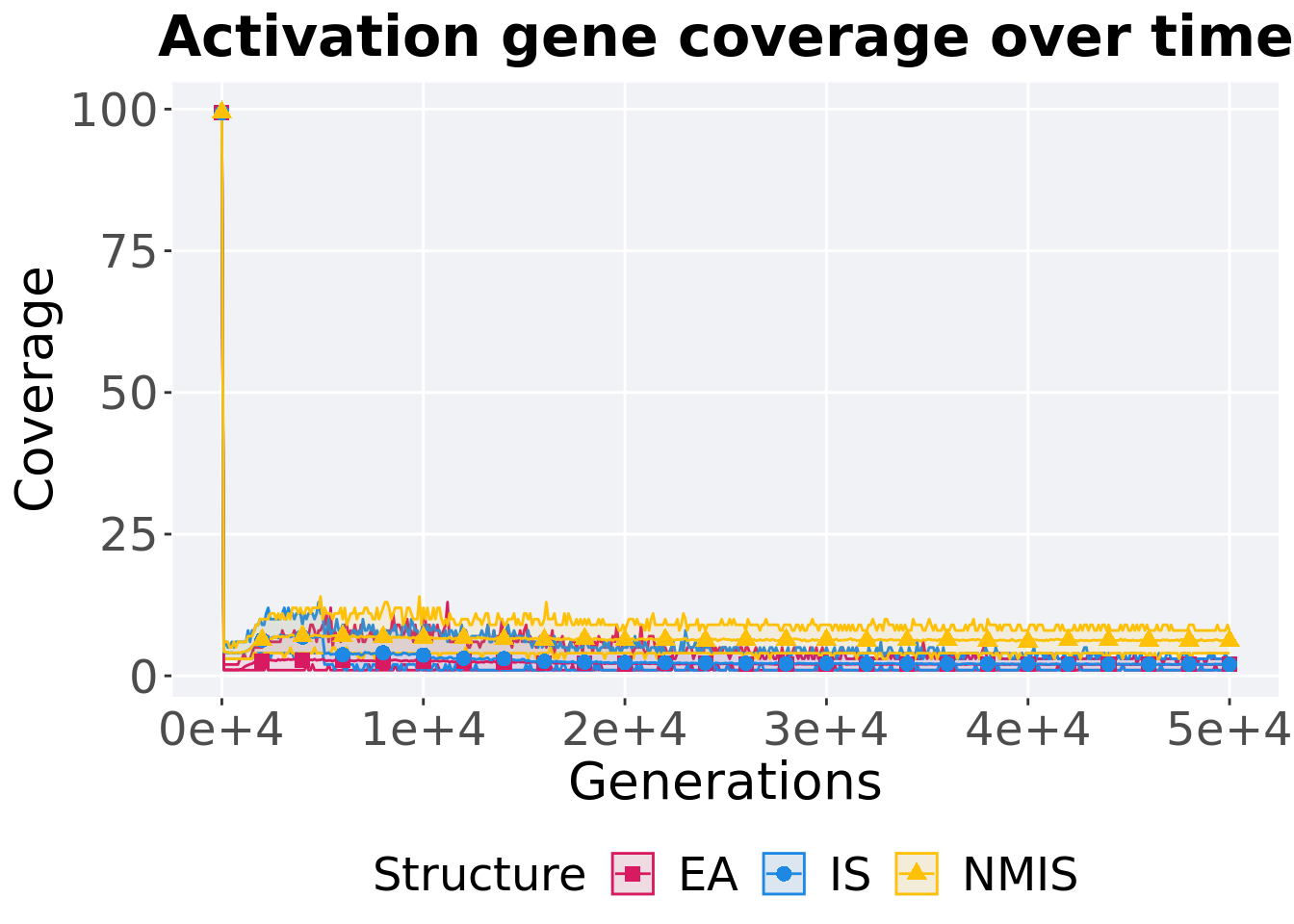
17.3.3.2 End of 50,000 generations
Activation gene coverage in the population at the end of 50,000 generations.
### end of run
filter(mi5000_over_time, Diagnostic == 'MULTIPATH_EXPLORATION' & `Selection\nScheme` == 'TOURNAMENT' & Generations == 50000) %>%
  ggplot(., aes(x = Structure, y = pop_act_cov, color = Structure, fill = Structure, shape = Structure)) +
  geom_flat_violin(position = position_nudge(x = .2, y = 0), scale = 'width', alpha = 0.3) +
  geom_point(position = position_jitter(height = .05, width = .05), size = 1.5, alpha = 0.5) +
  geom_boxplot(color = 'black', width = .2, outlier.shape = NA, alpha = 0.0) +
  scale_shape_manual(values=SHAPE)+
  scale_y_continuous(
    name="Coverage"
  ) +
  scale_x_discrete(
    name="Structure"
  ) +
  scale_colour_manual(values = cb_palette) +
  scale_fill_manual(values = cb_palette) +
  ggtitle('Final activation gene coverage')+
  p_theme + coord_flip()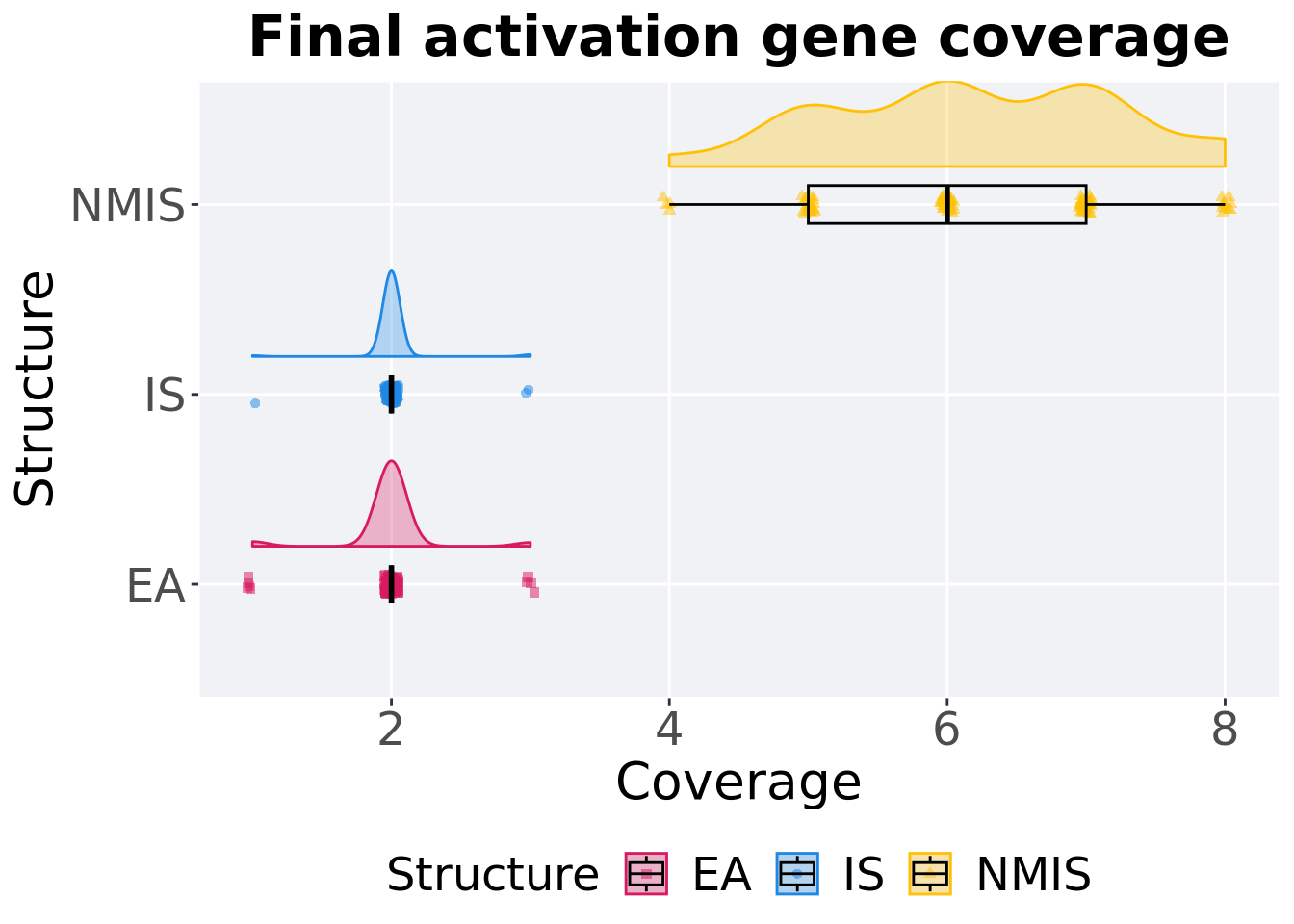
17.3.3.2.1 Stats
Summary statistics for activation gene coverage.
coverage = filter(mi5000_over_time, Diagnostic == 'MULTIPATH_EXPLORATION' & `Selection\nScheme` == 'TOURNAMENT' & Generations == 50000)
coverage %>%
  group_by(Structure) %>%
  dplyr::summarise(
    count = n(),
    na_cnt = sum(is.na(pop_act_cov)),
    min = min(pop_act_cov, na.rm = TRUE),
    median = median(pop_act_cov, na.rm = TRUE),
    mean = mean(pop_act_cov, na.rm = TRUE),
    max = max(pop_act_cov, na.rm = TRUE),
    IQR = IQR(pop_act_cov, na.rm = TRUE)
  )
## # A tibble: 3 x 8
## Structure count na_cnt min median mean max IQR
## <fct> <int> <int> <int> <dbl> <dbl> <int> <dbl>
## 1 EA 100 0 1 2 1.99 3 0
## 2 IS 100 0 1 2 2.01 3 0
## 3 NMIS 100 0 4 6 6.2 8 2Kruskal–Wallis test provides evidence of difference among activation gene coverage.
##
##  Kruskal-Wallis rank sum test
##
## data:  pop_act_cov by Structure
## Kruskal-Wallis chi-squared = 265.43, df = 2, p-value < 2.2e-16
Results for post-hoc Wilcoxon rank-sum test with a Bonferroni correction on activation gene coverage.
pairwise.wilcox.test(x = coverage$pop_act_cov, g = coverage$Structure, p.adjust.method = "bonferroni",
                     paired = FALSE, conf.int = FALSE, alternative = 'g')
##
## Pairwise comparisons using Wilcoxon rank sum test with continuity correction
##
## data: coverage$pop_act_cov and coverage$Structure
##
## EA IS
## IS 0.85 -
## NMIS <2e-16 <2e-16
##
## P value adjustment method: bonferroni17.4 Lexicase selection
Here we analyze how the different population structures affect standard lexicase selection on the contradictory objectives diagnostic.
17.4.1 Performance
17.4.1.1 Performance over time
lines = filter(mi5000_over_time, Diagnostic == 'MULTIPATH_EXPLORATION' & `Selection\nScheme` == 'LEXICASE') %>%
  group_by(Structure, Generations) %>%
  dplyr::summarise(
    min = min(pop_fit_max) / DIMENSIONALITY,
    mean = mean(pop_fit_max) / DIMENSIONALITY,
    max = max(pop_fit_max) / DIMENSIONALITY
  )
ggplot(lines, aes(x=Generations, y=mean, group = Structure, fill = Structure, color = Structure, shape = Structure)) +
  geom_ribbon(aes(ymin = min, ymax = max), alpha = 0.1) +
  geom_line(size = 0.5) +
  geom_point(data = filter(lines, Generations %% 2000 == 0), size = 2.5, stroke = 2.0, alpha = 1.0) +
  scale_y_continuous(
    name="Average trait score"
  ) +
  scale_x_continuous(
    name="Generations",
    limits=c(0, 50000),
    breaks=c(0, 10000, 20000, 30000, 40000, 50000),
    labels=c("0e+4", "1e+4", "2e+4", "3e+4", "4e+4", "5e+4")

  ) +
  scale_shape_manual(values=SHAPE)+
  scale_colour_manual(values = cb_palette) +
  scale_fill_manual(values = cb_palette) +
  ggtitle("Performance over time") +
  p_theme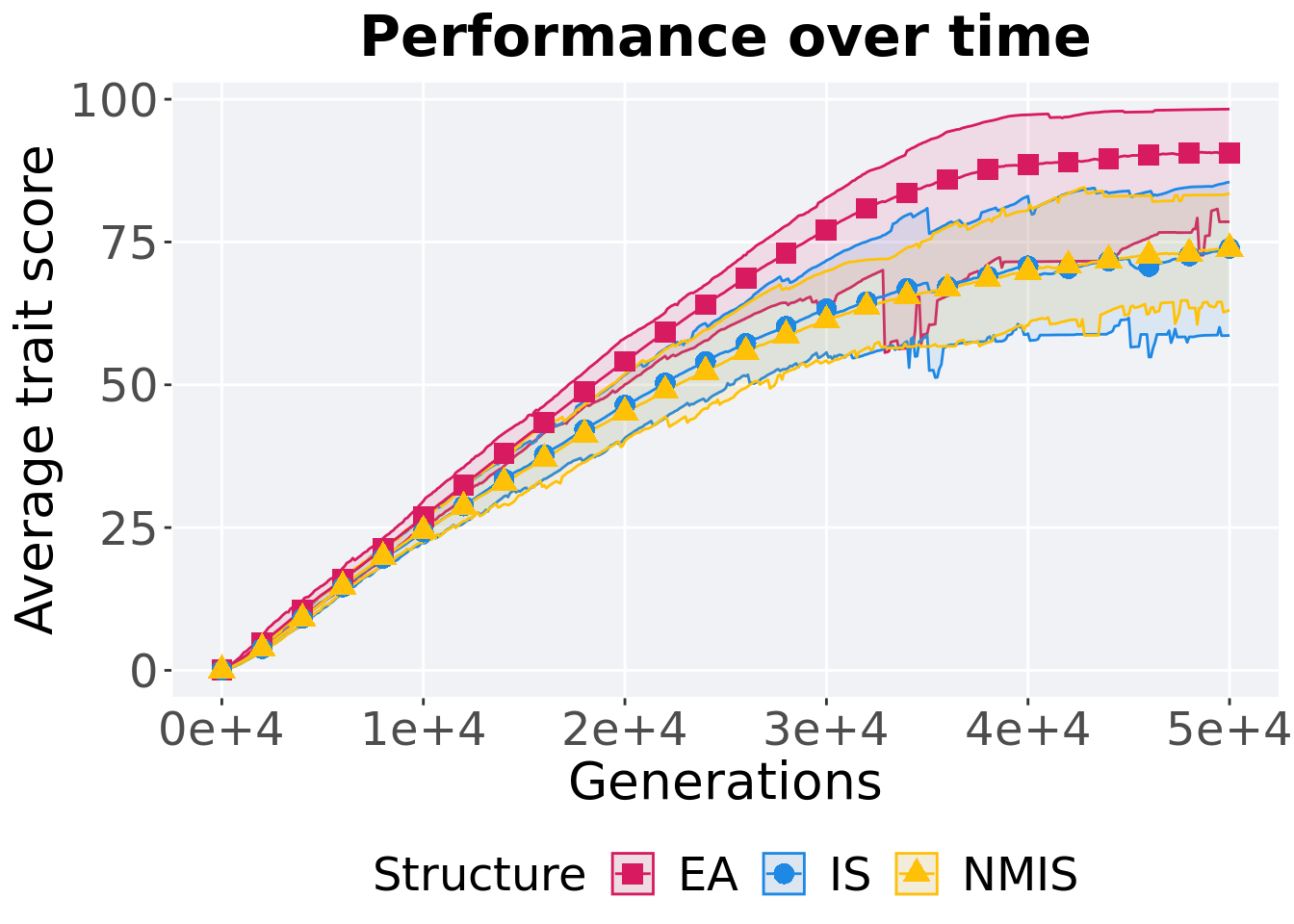
17.4.1.2 Best performance
First generation a satisfactory solution is found throughout the 50,000 generations.
filter(mi5000_best, Diagnostic == 'MULTIPATH_EXPLORATION' & `Selection\nScheme` == 'LEXICASE' & VAR == 'pop_fit_max') %>%
  ggplot(., aes(x = Structure, y = VAL / DIMENSIONALITY, color = Structure, fill = Structure, shape = Structure)) +
  geom_flat_violin(position = position_nudge(x = .2, y = 0), scale = 'width', alpha = 0.2) +
  geom_point(position = position_jitter(width = .1), size = 1.5, alpha = 1.0) +
  geom_boxplot(color = 'black', width = .2, outlier.shape = NA, alpha = 0.0) +
  scale_y_continuous(
    name="Average trait score"
  ) +
  scale_x_discrete(
    name="Structure"
  )+
  scale_shape_manual(values=SHAPE)+
  scale_colour_manual(values = cb_palette, ) +
  scale_fill_manual(values = cb_palette) +
  ggtitle('Best performance')+
  p_theme + coord_flip()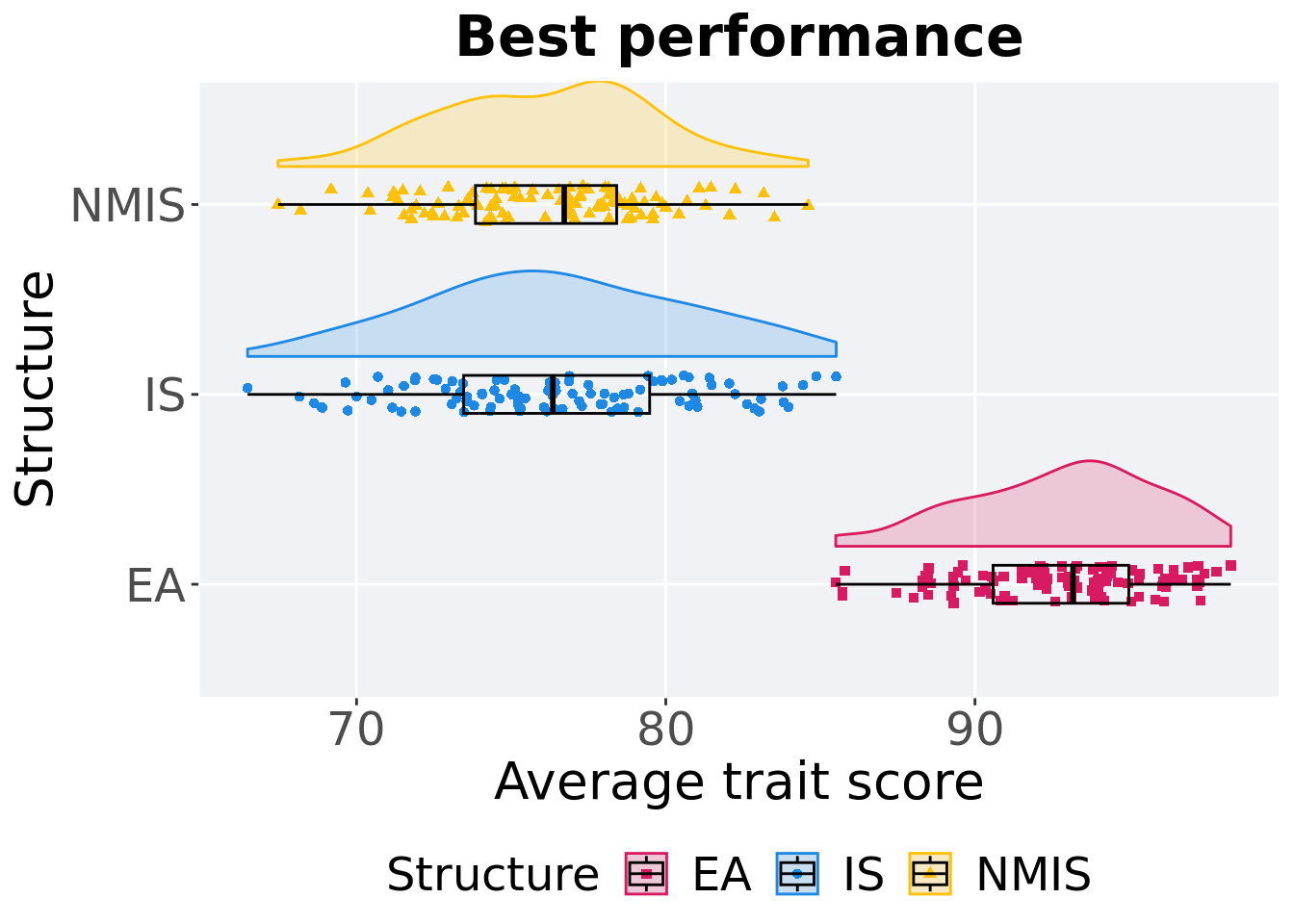
17.4.1.2.1 Stats
Summary statistics for the first generation a satisfactory solution is found.
performance = filter(mi5000_best, Diagnostic == 'MULTIPATH_EXPLORATION' & `Selection\nScheme` == 'LEXICASE' & VAR == 'pop_fit_max')
performance$Structure = factor(performance$Structure, levels=c('EA','NMIS','IS'))
performance %>%
  group_by(Structure) %>%
  dplyr::summarise(
    count = n(),
    na_cnt = sum(is.na(VAL)),
    min = min(VAL, na.rm = TRUE) / DIMENSIONALITY,
    median = median(VAL, na.rm = TRUE) / DIMENSIONALITY,
    mean = mean(VAL, na.rm = TRUE) / DIMENSIONALITY,
    max = max(VAL, na.rm = TRUE) / DIMENSIONALITY,
    IQR = IQR(VAL, na.rm = TRUE) / DIMENSIONALITY
  )
## # A tibble: 3 x 8
## Structure count na_cnt min median mean max IQR
## <fct> <int> <int> <dbl> <dbl> <dbl> <dbl> <dbl>
## 1 EA 100 0 85.5 93.2 92.8 98.3 4.39
## 2 NMIS 100 0 67.5 76.7 76.2 84.6 4.57
## 3 IS 100 0 66.5 76.3 76.4 85.5 6.01Kruskal–Wallis test provides evidence of difference among selection schemes.
##
##  Kruskal-Wallis rank sum test
##
## data:  VAL by Structure
## Kruskal-Wallis chi-squared = 199.33, df = 2, p-value < 2.2e-16
Results for post-hoc Wilcoxon rank-sum test with a Bonferroni correction.
pairwise.wilcox.test(x = performance$VAL, g = performance$Structure, p.adjust.method = "bonferroni",
                     paired = FALSE, conf.int = FALSE, alternative = 'l')
##
## Pairwise comparisons using Wilcoxon rank sum test with continuity correction
##
## data: performance$VAL and performance$Structure
##
## EA NMIS
## NMIS <2e-16 -
## IS <2e-16 1
##
## P value adjustment method: bonferroni17.4.1.3 Final performance
First generation a satisfactory solution is found throughout the 50,000 generations.
filter(mi5000_over_time, Diagnostic == 'MULTIPATH_EXPLORATION' & `Selection\nScheme` == 'LEXICASE' & Generations == 50000) %>%
  ggplot(., aes(x = Structure, y = pop_fit_max / DIMENSIONALITY, color = Structure, fill = Structure, shape = Structure)) +
  geom_flat_violin(position = position_nudge(x = .2, y = 0), scale = 'width', alpha = 0.2) +
  geom_point(position = position_jitter(width = .1), size = 1.5, alpha = 1.0) +
  geom_boxplot(color = 'black', width = .2, outlier.shape = NA, alpha = 0.0) +
  scale_y_continuous(
    name="Average trait score"
  ) +
  scale_x_discrete(
    name="Structure"
  )+
  scale_shape_manual(values=SHAPE)+
  scale_colour_manual(values = cb_palette, ) +
  scale_fill_manual(values = cb_palette) +
  ggtitle('Final performance')+
  p_theme + coord_flip()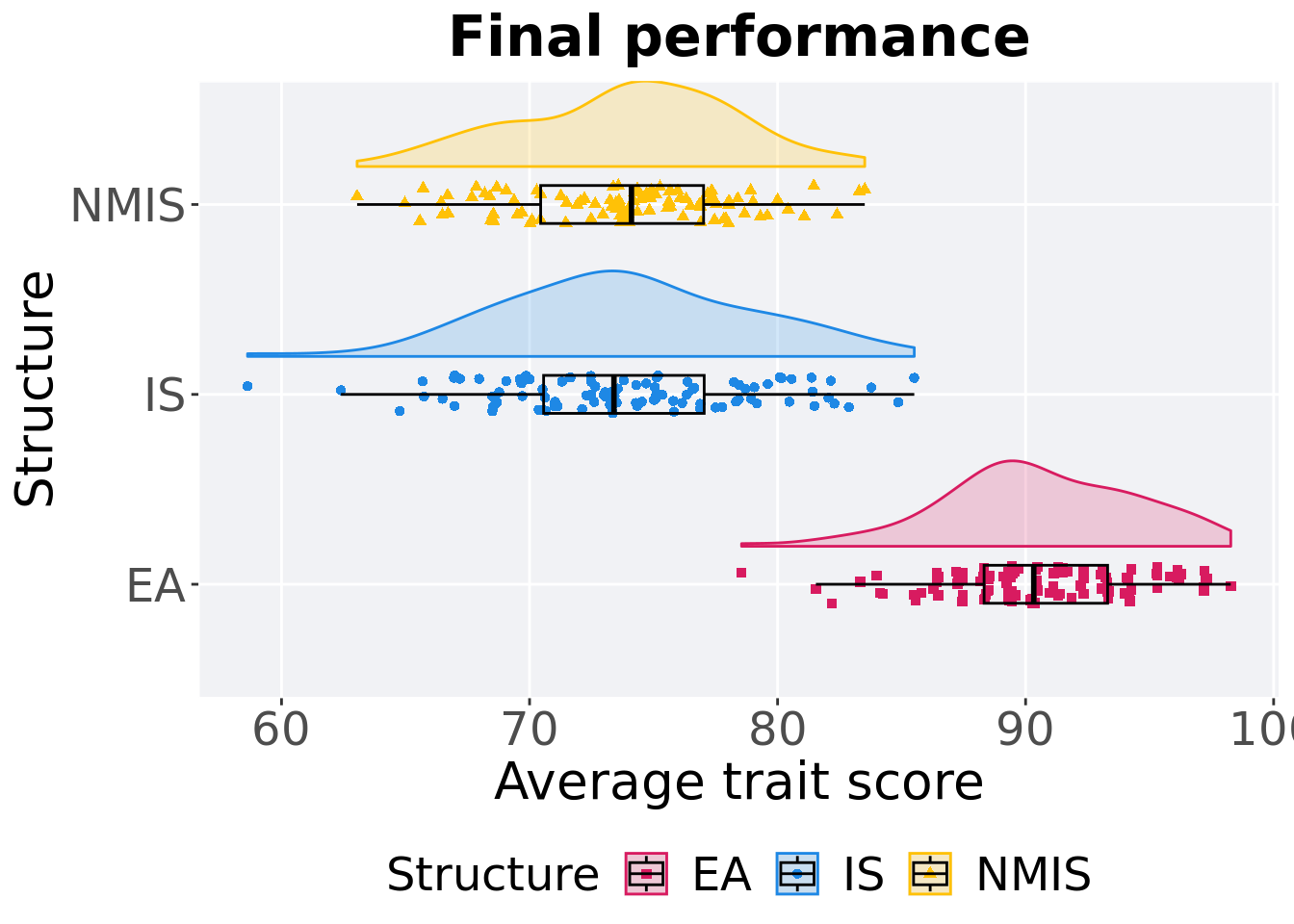
17.4.1.3.1 Stats
Summary statistics for the first generation a satisfactory solution is found.
performance = filter(mi5000_over_time, Diagnostic == 'MULTIPATH_EXPLORATION' & `Selection\nScheme` == 'LEXICASE' & Generations == 50000)
performance$Structure = factor(performance$Structure, levels=c('EA','NMIS','IS'))
performance %>%
  group_by(Structure) %>%
  dplyr::summarise(
    count = n(),
    na_cnt = sum(is.na(pop_fit_max)),
    min = min(pop_fit_max / DIMENSIONALITY, na.rm = TRUE),
    median = median(pop_fit_max / DIMENSIONALITY, na.rm = TRUE),
    mean = mean(pop_fit_max / DIMENSIONALITY, na.rm = TRUE),
    max = max(pop_fit_max / DIMENSIONALITY, na.rm = TRUE),
    IQR = IQR(pop_fit_max / DIMENSIONALITY, na.rm = TRUE)
  )
## # A tibble: 3 x 8
## Structure count na_cnt min median mean max IQR
## <fct> <int> <int> <dbl> <dbl> <dbl> <dbl> <dbl>
## 1 EA 100 0 78.5 90.3 90.5 98.3 4.98
## 2 NMIS 100 0 63.0 74.1 73.9 83.5 6.57
## 3 IS 100 0 58.6 73.4 73.9 85.5 6.47Kruskal–Wallis test provides evidence of difference among selection schemes.
##
##  Kruskal-Wallis rank sum test
##
## data:  pop_fit_max by Structure
## Kruskal-Wallis chi-squared = 196.97, df = 2, p-value < 2.2e-16
Results for post-hoc Wilcoxon rank-sum test with a Bonferroni correction.
pairwise.wilcox.test(x = performance$pop_fit_max, g = performance$Structure, p.adjust.method = "bonferroni",
                     paired = FALSE, conf.int = FALSE, alternative = 'l')
##
## Pairwise comparisons using Wilcoxon rank sum test with continuity correction
##
## data: performance$pop_fit_max and performance$Structure
##
## EA NMIS
## NMIS <2e-16 -
## IS <2e-16 1
##
## P value adjustment method: bonferroni17.4.2 Activation gene coverage
Activation gene coverage analysis.
17.4.2.1 Coverage over time
Activation gene coverage over time.
# data for lines and shading on plots
lines = filter(mi5000_over_time, Diagnostic == 'MULTIPATH_EXPLORATION' & `Selection\nScheme` == 'LEXICASE') %>%
  group_by(Structure, Generations) %>%
  dplyr::summarise(
    min = min(pop_act_cov),
    mean = mean(pop_act_cov),
    max = max(pop_act_cov)
  )
## `summarise()` has grouped output by 'Structure'. You can override using the
## `.groups` argument.ggplot(lines, aes(x=Generations, y=mean, group = Structure, fill = Structure, color = Structure, shape = Structure)) +
geom_ribbon(aes(ymin = min, ymax = max), alpha = 0.1) +
geom_line(size = 0.5) +
geom_point(data = filter(lines, Generations %% 2000 == 0), size = 1.5, stroke = 2.0, alpha = 1.0) +
scale_y_continuous(
name="Coverage"
) +
scale_x_continuous(
name="Generations",
limits=c(0, 50000),
breaks=c(0, 10000, 20000, 30000, 40000, 50000),
labels=c("0e+4", "1e+4", "2e+4", "3e+4", "4e+4", "5e+4")
) +
scale_shape_manual(values=SHAPE)+
scale_colour_manual(values = cb_palette) +
scale_fill_manual(values = cb_palette) +
ggtitle('Activation gene coverage over time')+
p_theme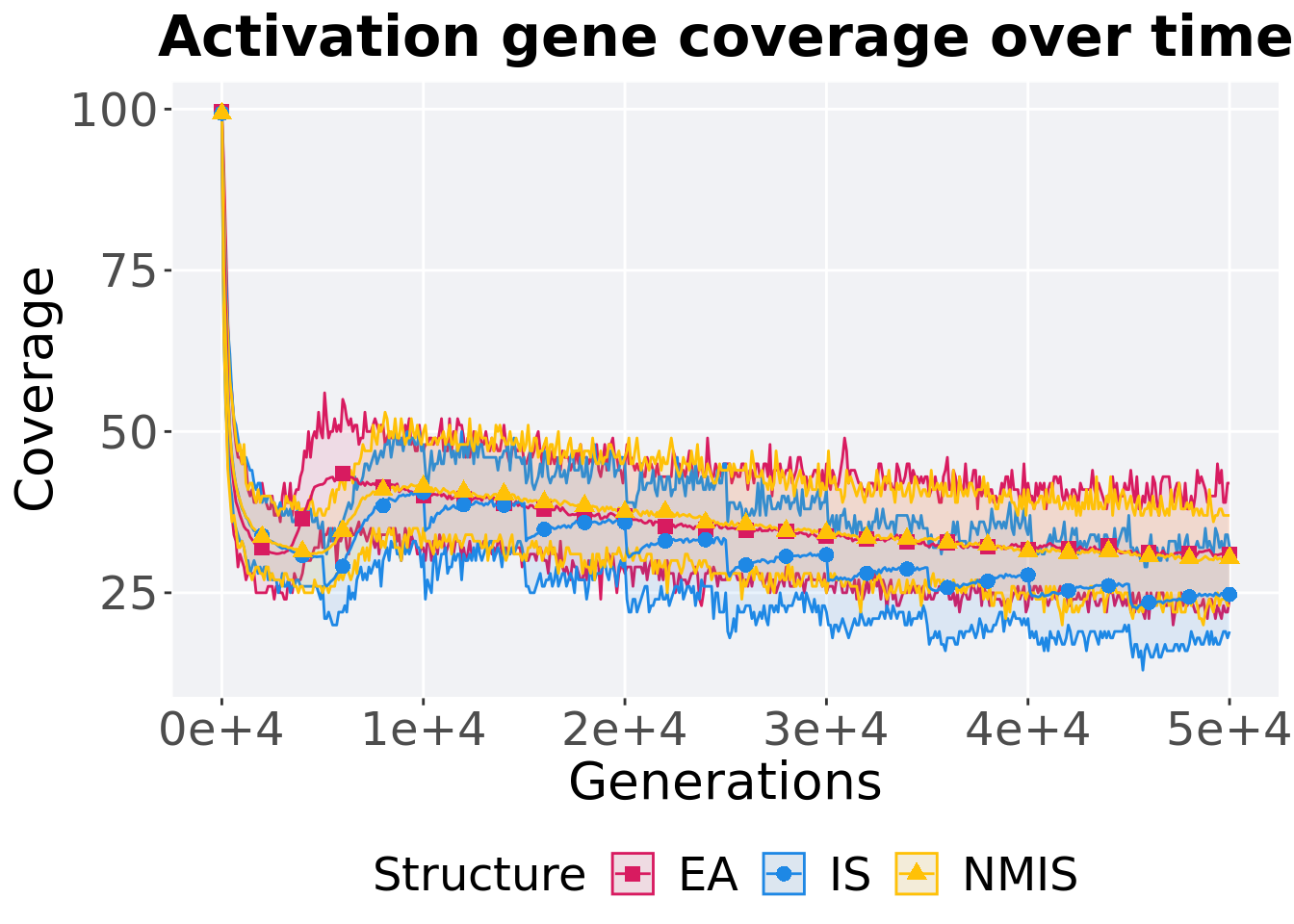
17.4.2.2 End of 50,000 generations
Activation gene coverage in the population at the end of 50,000 generations.
### end of run
filter(mi5000_over_time, Diagnostic == 'MULTIPATH_EXPLORATION' & `Selection\nScheme` == 'LEXICASE' & Generations == 50000) %>%
  ggplot(., aes(x = Structure, y = pop_act_cov, color = Structure, fill = Structure, shape = Structure)) +
  geom_flat_violin(position = position_nudge(x = .2, y = 0), scale = 'width', alpha = 0.3) +
  geom_point(position = position_jitter(height = .05, width = .05), size = 1.5, alpha = 0.5) +
  geom_boxplot(color = 'black', width = .2, outlier.shape = NA, alpha = 0.0) +
  scale_shape_manual(values=SHAPE)+
  scale_y_continuous(
    name="Coverage"
  ) +
  scale_x_discrete(
    name="Structure"
  ) +
  scale_colour_manual(values = cb_palette) +
  scale_fill_manual(values = cb_palette) +
  ggtitle('Final activation gene coverage')+
  p_theme + coord_flip()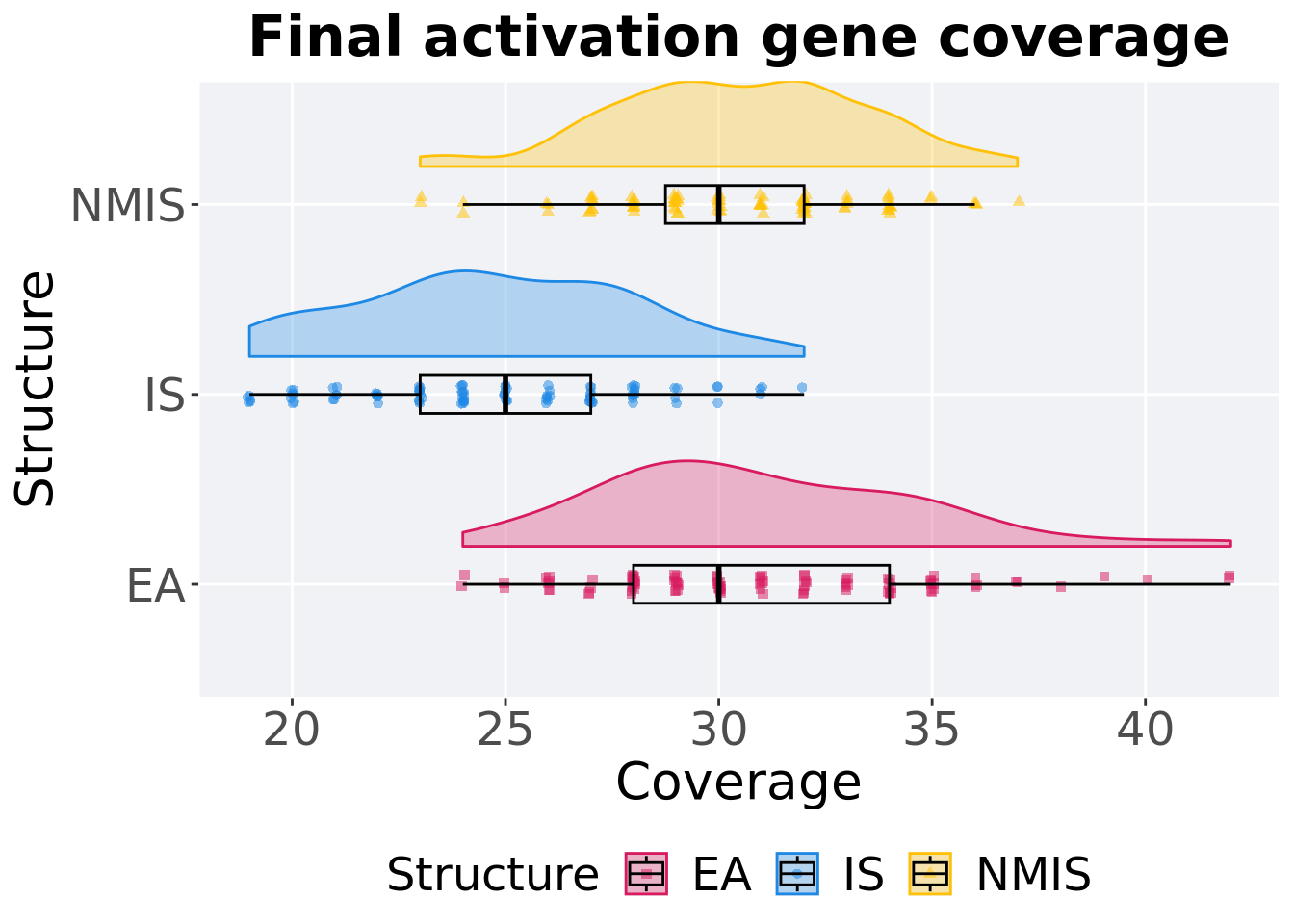
17.4.2.2.1 Stats
Summary statistics for activation gene coverage.
coverage = filter(mi5000_over_time, Diagnostic == 'MULTIPATH_EXPLORATION' & `Selection\nScheme` == 'LEXICASE' & Generations == 50000)
coverage$Structure = factor(coverage$Structure, levels=c('EA','NMIS','IS'))
coverage %>%
  group_by(Structure) %>%
  dplyr::summarise(
    count = n(),
    na_cnt = sum(is.na(pop_act_cov)),
    min = min(pop_act_cov, na.rm = TRUE),
    median = median(pop_act_cov, na.rm = TRUE),
    mean = mean(pop_act_cov, na.rm = TRUE),
    max = max(pop_act_cov, na.rm = TRUE),
    IQR = IQR(pop_act_cov, na.rm = TRUE)
  )
## # A tibble: 3 x 8
## Structure count na_cnt min median mean max IQR
## <fct> <int> <int> <int> <dbl> <dbl> <int> <dbl>
## 1 EA 100 0 24 30 31 42 6
## 2 NMIS 100 0 23 30 30.4 37 3.25
## 3 IS 100 0 19 25 24.8 32 4Kruskal–Wallis test provides evidence of difference among activation gene coverage.
##
##  Kruskal-Wallis rank sum test
##
## data:  pop_act_cov by Structure
## Kruskal-Wallis chi-squared = 130.57, df = 2, p-value < 2.2e-16
Results for post-hoc Wilcoxon rank-sum test with a Bonferroni correction on activation gene coverage.
pairwise.wilcox.test(x = coverage$pop_act_cov, g = coverage$Structure, p.adjust.method = "bonferroni",
                     paired = FALSE, conf.int = FALSE, alternative = 'l')
##
## Pairwise comparisons using Wilcoxon rank sum test with continuity correction
##
## data: coverage$pop_act_cov and coverage$Structure
##
## EA NMIS
## NMIS 0.81 -
## IS <2e-16 <2e-16
##
## P value adjustment method: bonferroni